83% percent of companies still design territories with spreadsheets. That number gets cited a lot in the context of annual planning — the grueling Q4 ritual of pivot tables, negotiated fairness, and six rounds of leadership feedback before anything gets published to the sales team.
But annual planning is only one of the moments when territories break down. It's not even the hardest one.
The harder moments are the ones nobody scheduled: the rep who left in February. The two new hires starting next Monday who don't have accounts yet. The Q1 that closed unevenly across the team and now leadership is asking whether the territories were ever fair to begin with. These situations don't arrive with six weeks of runway. They arrive with a Slack message and a deadline of end of week.
This is where most territory tools fail. They're built for the annual planning event, not for the other eleven months. What follows are the 6 territory questions we see RevOps teams searching for right now, and how Carve handles each one (you can try Carve for free!).
1. How do I rebalance territories after a rep leaves?
When a rep exits mid-year, their accounts don't sit idle waiting for annual planning. They get informally absorbed by whoever's nearby, or they pile into a queue, or a manager starts manually reassigning them in Salesforce based on gut instinct. None of these are good outcomes.
The real problem isn't redistributing the accounts; it's doing it in a way that's fair, explainable and fast enough to matter. If you're using a spreadsheet, you're probably making decisions based on geography and gut feel, with no visibility into workload balance across the receiving reps.
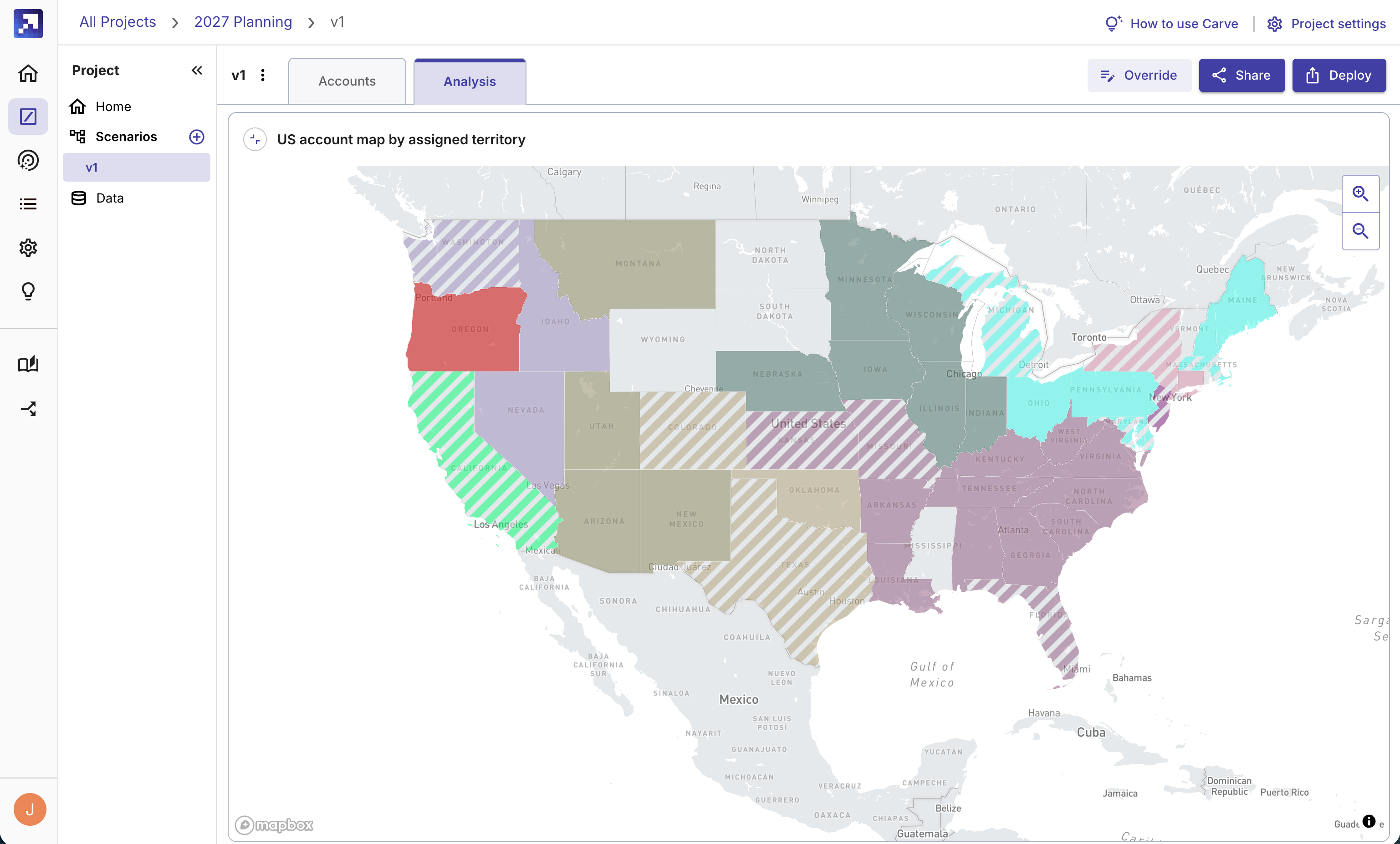
Carve handles this in a single session. Describe the situation in plain language — headcount, fairness criteria, account criteria, any constraints — and it generates territory options with account-level explanations. The output tells you not just where an account landed, but why. That matters when you have to explain the redistribution to six reps who all think they deserved the best accounts.
The same applies when you inherit territories you didn't build. A new RevOps hire or someone stepping into a departed colleague's role typically spends a full day reconstructing how the previous person set things up before they can even start rebalancing. Carve eliminates that orientation phase. You just feed in the data, generate a starting point, and work from there.
2. How do I assign a fair territory to a new sales rep?
New reps often get the worst territories. They show up on Monday, they need accounts to work, and someone assigns them whatever's leftover after the last carve. It's not intentional; it's just what happens when territory design is a big annual event and there's no lightweight process for handling headcount changes in between.
A territory sized for a fully ramped rep is the wrong starting point for someone in their first 90 days. The account volume, deal complexity, and workload expectations need to reflect where they are in their ramp. And whatever they get, it needs to be defensible to them. New reps are paying close attention to whether leadership treats them fairly, and a territory that feels arbitrary is a bad first impression.
Carve generates ramp-appropriate territories from available accounts without requiring a full planning session. Describe what you need — "two new reps starting in the Northeast, ramping over 90 days, prioritize accounts with fewer than 500 employees" — and it handles the account math. The explanation layer matters here too: when you can show a new rep exactly why they have the accounts they have, the conversation about their territory starts from a different place.
3. How do I measure territory fairness?
This is the question that usually comes after Q1 closes unevenly. Leadership looks at attainment by rep, sees meaningful variance, and asks whether the territories were ever balanced. RevOps starts pulling data, builds a territory equity analysis in Excel, and tries to determine whether the gap is a performance issue or a design issue.
Measuring territory fairness after the fact is hard. Measuring it before the carve goes live is harder, because the spreadsheet process doesn't naturally produce the analysis you'd need.
Carve builds fairness constraints into the territory design process itself. You describe what "fair" means — equal revenue potential, equal account count, balanced segment mix, similar workload — and it produces territory options that satisfy those constraints, along with explanations of how it evaluated each account assignment.
This changes the post-close conversation. When territory equity is documented in the tool rather than reconstructed from Salesforce exports, you have the receipts. If Q2 closes unevenly, you can distinguish between a territory design problem and a rep performance problem. That's a better place to start than six hours of spreadsheet forensics.
Kasin Bennett, Head of Revenue Operations at Attentive, describes what this means in practice: "There's less of a chance of AEs not hitting quota... that takes one of the 20 reasons why an AE won't hit quota out of the picture. I think of it like more trust between RevOps and sales, that their books are good."
4. How do I get leadership to approve a territory change?
Getting leadership to sign off on a territory plan is often the bottleneck — not building the plan itself. You present one option, leadership has questions you can't answer without going back to the spreadsheet, you rebuild, they have more questions, the cycle repeats.
The issue is that the traditional process makes it expensive to explore alternatives. If building one scenario takes three days, you can't afford to show leadership three genuinely different options. So you present your best guess, defend it, and hope.
Carve makes scenario generation fast enough that presenting options becomes the default. Generate a version that prioritizes enterprise accounts, one that balances deal count across segments, and one that weights for geographic density, and let leadership choose. The explanation layer means each option comes with a rationale built in, so you're not the one defending the plan; the plan defends itself.
Kasin Bennett puts it directly: "It's being able to come to James with options, saying, I carved the books in four different ways. What do you think is the most equitable? Option A is most equitable from a geographic location. Option B is most equitable from total white space. Option C is most equitable from the number of hierarchies."
That's a different kind of leadership conversation — collaborative rather than defensive.
5. Are our territories causing rep attrition?
Sales rep attrition is expensive. Recruiting, onboarding, ramp time: the fully loaded cost of replacing an AE is significant, and territory inequity is one of the quieter drivers of dissatisfaction that eventually tips into departure.
Reps are good at pattern-matching. They talk to each other. If one rep is working twice as hard as another for similar quota, they notice, and they draw conclusions about whether leadership is paying attention. A territory that feels arbitrary or unfair is one of those "20 reasons an AE won't hit quota" and it's one of the few that RevOps can actually fix.
The connection between territory design and retention is most compelling for sales leaders who are skeptical of RevOps tooling spend. The pitch for territory design software usually focuses on RevOps efficiency — and that's real. But the retention argument hits differently at the CRO level: equitable territories reduce one of the structural reasons strong reps leave.
Carve's explainability feature matters here beyond the initial carve. When reps can see why accounts were assigned the way they were (not just what they received) territory equity stops being an assertion and becomes something you can show them. That's harder to dispute and easier to trust.
6. How do I rebalance territories without disrupting active deals?
Mid-year territory changes feel risky because they can disrupt relationships and active pipeline. That risk is real, but it often gets used as a reason to avoid making changes that are clearly necessary — which has its own cost in coverage gaps, rep burnout, and underserved accounts.
The problem is that the spreadsheet process doesn't give you the tools to minimize disruption thoughtfully. You're making account-level decisions manually, trying to hold deal status in your head, and hoping you haven't accidentally reassigned something that was 30 days from closing.
A mid-year re-carve in Carve is a different kind of project. You can describe constraints explicitly — protect accounts with open opportunities, don't move accounts with meetings scheduled in the next 30 days, prioritize redistributing unworked accounts first — and let the AI apply those rules consistently across thousands of accounts. The result is a rebalanced territory map that minimizes in-flight disruption rather than one that maximizes fairness at the expense of everything else.
That's the reframe that makes mid-year rebalancing feel less risky: you're not choosing between fairness and disruption. You can have both if your tooling lets you encode both constraints.
Territory planning doesn't have an off-season
Annual planning is still the highest-stakes territory moment. But the question we hear most often right now is how to handle the other eleven months. The rep who left, the new hire who's waiting, the leadership question that needs an answer by Thursday.
Palen Schwab, Head of Solutions Engineering at Liquibase, had done territory carves for a decade before using Carve. His take: "I've carved territories the last 10 years, right? It's never fun. It's something I want to basically eliminate from my job. But after using Carve: I'm looking forward to doing my next carve."
If your territory process only runs once a year, every other problem becomes a crisis. The goal is a process that can run whenever you need it.
Want to see how Carve handles your specific situation? Try it free.