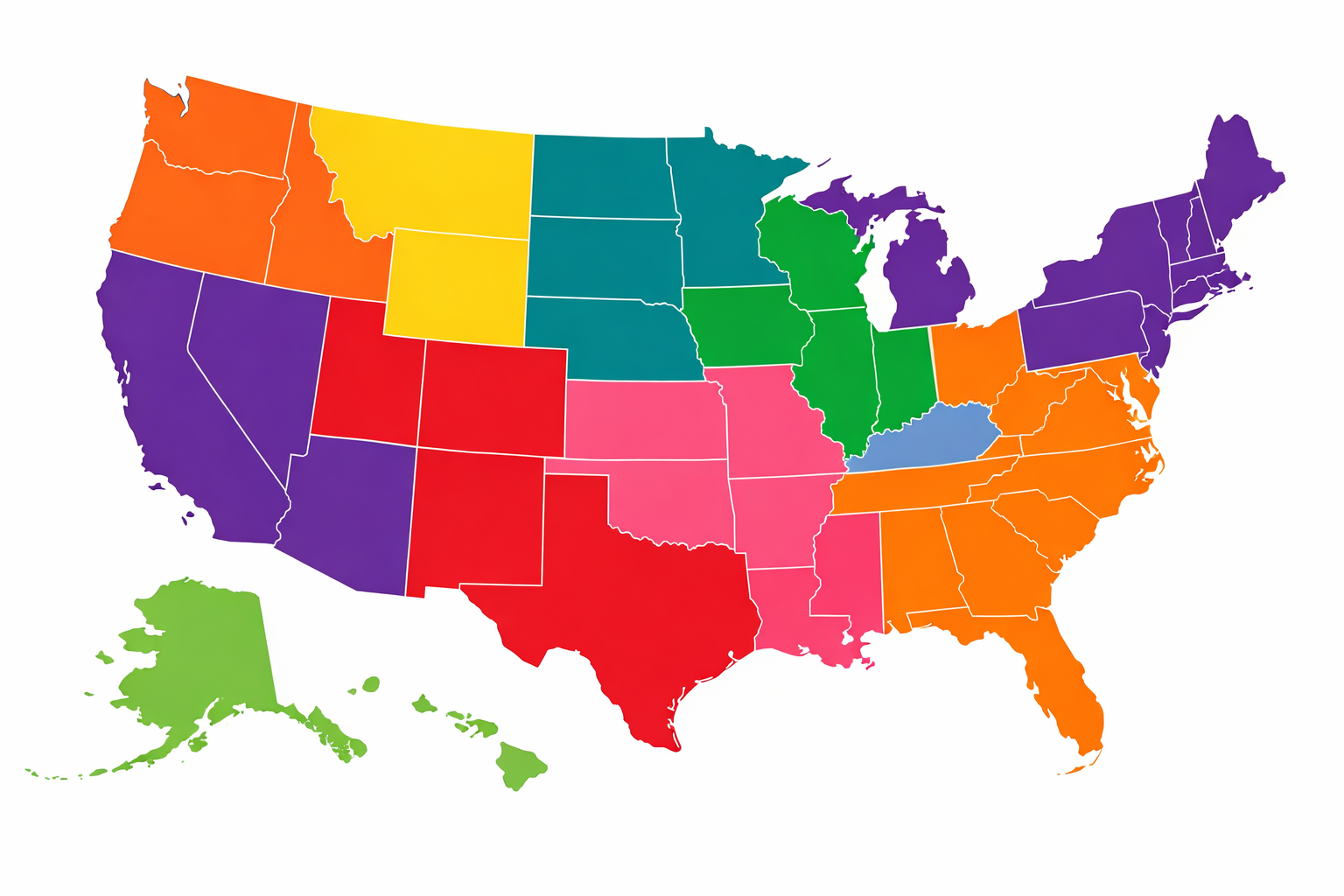
Geographic sales territories date back to 1919. We've been using them for over 100 years because we had to- poor railroads, no video calls, no CRM. Even the guy who literally wrote the book on sales territories called state-line-based carving "old fashioned." That was in 1919.
The fact is that most companies are running the wrong model for their particular sales motion. Today: 76% of companies still use geographic territories. 83% still plan with spreadsheets. Only 53% of sales reps regularly hit quota.
Why do so few reps hit quota? One big reason is the mismatch between how a team sells and how its accounts are organized.
Territory models aren't one-size-fits-all
There's a full continuum of territory models, and each one is right for a different sales motion:
| Model | Best For |
| Geographic | Field sales, in-person customer visits, regional regulatory variation |
| Named accounts | Enterprise, long sales cycles, relationship-driven deals, small number of large accounts |
| Vertical | Deep industry specialization where rep expertise is the differentiator |
| Round robin | Mostly inbound teams, short cycles, small team, similar rep tenure |
| Dynamic books | Inside sales, fast cycles, hybrid inbound/outbound, large TAMs |
These models can - and often should - coexist within one organization. Box runs named accounts on enterprise and dynamic books on SMB inside sales. A SaaS company might run vertical territories for their regulated-industry segment while running dynamic books for commercial. The right question isn't which model is best. It's which model fits which motion.
When geographic territories are the right answer
For field sales teams, geography isn't arbitrary — it's operational. A rep who visits customers in person can't reasonably cover accounts 1,500 miles away. Regional regulatory variation can require local expertise. Relationship patterns often follow geography.
Geographic territories work when the physical or regulatory reality of selling demands regional coverage. The problem is when companies apply them to motions where geography is irrelevant, like inside sales teams where every call is a video call and every rep can work any account in the country equally well.
When named accounts are the right answer
Enterprise sales is fundamentally different from commercial inside sales. Deals take longer. Relationships matter more. There are fewer accounts, but each one is worth more. In this context, carving accounts into geographic slices doesn't make sense — the target list is small enough to assign directly, and reps need to own their accounts over the long term to build the relationships that close enterprise deals.
Named account models work when you have high confidence in your target list, long sales cycles, and a motion that depends on deep relationship development. What breaks them is assigning too many accounts per rep, or letting books go stale: good accounts sitting untouched because nobody ever reviewed whether the assignment still makes sense.
So keep your named accounts model for this kind of team, but build in periodic account-quality reviews, so assignments stay fresh and reps aren't sitting on accounts that no longer fit.
When inside sales teams get the model wrong
For inside sales - especially high-velocity commercial teams with TAMs too large for any rep to fully cover - geographic territories are the wrong model applied to the wrong motion.
Static territory models break down for inside sales in two predictable ways.
The legacy territory problem. You carve up your TAM once a year, assign reps to their slices, and hope for the best. Here's what actually happens:
- Some reps sit on territories packed with high-potential accounts they can't possibly work. Others fight for scraps.
- You hand someone 1,000 accounts and say "go sell." They spend their time figuring out who to call instead of actually calling.
- A rep leaves or gets hired and the whole thing falls apart. Time to re-carve. It takes days, it's political, and it disrupts the entire team.
- Good accounts sit untouched in someone's territory because that rep is busy with the 20 accounts they already know. Nobody notices until the quarter is missed.
The wild west problem. Some teams swing the other direction: no territories, every rep for themselves. Different problem, same result. Long-tenured reps accumulate hundreds of accounts and sit on all the best inbounds. New reps pick through the dregs. Without defined books, you can't measure coverage or hold reps accountable for working specific accounts.
Both failure modes lead to the same place: missed quota, burned-out reps, and a pipeline that never quite adds up.
Dynamic books: The model built for inside sales
Dynamic books is a rethinking of how inside sales teams operate. Instead of carving up a TAM into static territories once a year and assigning thousands of accounts to each rep, dynamic books gives every rep a small, continuously refreshed set of high-potential accounts to work.
When accounts convert, get disqualified, or go cold, they cycle out and new ones cycle in. Reps stay focused on what's workable. Coverage stays visible.
The core shift:
| Static territories | Dynamic books | |
| Account list | Fixed for a period (usually annual, sometimes quarterly) | Continuously refreshed |
| What's fixed | The territory (accounts) | The rep (capacity) |
| Book size | Hundreds to thousands | 100–300 active accounts |
| Planning cycle | Annual | Continuous |
| Account ownership | Permanent until re-carving | Use it or lose it |
Five things changed that make a dynamic model viable for inside sales teams today:
- Remote work removed the geographic constraint for most inside sales motions
- Better data and CRM tech make account-level prioritization real
- Sales engagement tools support quality outreach on smaller books
- AI enables account research, scoring, and enrichment at scale
- Markets move too fast for annual planning to keep up
The numbers that make the case for dynamic books
- Win rate: 13% → 20% in one year
- +50% more opportunities vs. static territories in head-to-head comparison
- +16% opp creation in one month
- +18% meeting rate increase
- Book sizes reduced from thousands to 100–250 per rep
- New reps hitting quota within 4 months
The math on why is straightforward. Take Jane and Joe. Jane has Northern Arkansas: 100 accounts, 20 high-quality. Joe has Northern California: 100 accounts, all 100 high-quality. Each rep can realistically work 60 accounts. At 10% conversion on high-quality accounts:
Static territories: Jane works her 20 good accounts and 40 bad ones → 2 opps. Joe works his best 60 → 6 opps. Total: 8 opps. 6.7% book productivity.
Dynamic books: Jane and Joe split the 120 high-quality accounts evenly. Each works 60 → 6 opps each. Total: 12 opps. 10% book productivity. That's 50% more opportunities from the same accounts and the same reps. Nobody did anything differently except get better accounts.
"We used to hand reps zip codes. Now, we hand them opportunity." — Nora Soza, Sr Director GTM Strategy & Operations, Box
Three metrics that matter regardless of model
Whatever territory model you run, these three metrics tell you whether it's working:
- Account coverage: What percentage of accounts in a segment are being engaged? Most teams measure activity in aggregate but have no visibility into what portion of their market reps are actually touching.
- Opportunity creation rate: What percentage of engaged accounts become opps? This tells you how efficiently reps convert prospects into pipeline, and where conversion rates differ across segments or reps.
- Incubation period: How long from account assignment to first meeting? This tells you where delays are in the path from assignment to engagement.
If pipeline lags while activity looks fine, these three metrics tell you exactly where it's breaking. Low coverage means reps aren't working enough accounts. Low OCR means they're working the wrong ones. Long incubation means something is slowing the path to engagement.
So which territory design is best?
The right territory model isn't a universal answer. It's a decision based on your sales motion, your team structure, and your market.
Field sales teams need geographic coverage. Enterprise teams need named accounts and the relationship continuity that comes with them. Inside sales teams working large TAMs need dynamic books that keep reps focused on the highest-potential accounts at any given moment.
The teams that struggle aren't the ones using geographic territories or named accounts. They're the ones running the wrong model for their motion, or the right model, but without the tools to keep it working as the team and market change.
If you want to see how dynamic books could work for your sales team, request a Gradient Works demo here. If you want to take a look at the effectiveness of your current territory design - regardless of model - try Carve for free.