




Quick question: when your outbound pipeline is down, what do you fix first?
If you're like most sales leaders, you go for the familiar levers. You push for more activity. You review the sequences and tighten up the messaging. You invest in better contact data so reps are reaching the right people. These all feel like reasonable moves. They're also almost always the wrong place to start.
The real problem is usually at the bottom of the stack — and most teams never look there.
Most outbound is diagnosed from the top down
There's a mental model most sales teams use, whether they've named it or not. It treats outbound performance as a set of layers:
|
Layer |
What teams usually ask |
|
4. Activity |
Are reps putting in the work? |
|
3. Messaging |
Is the pitch compelling enough? |
|
2. Contacts |
Are reps reaching the right people? |
|
1. Accounts |
Are reps targeting the right accounts? |
When pipeline is down, the instinct is to pull on layer 4 first — "make more calls" — and work down from there. Messaging gets workshopped. Contact data gets refreshed. And somewhere at the bottom, account selection sits untouched, assumed to be fine.
It's not fine.
The foundation problem
Here's the thing about outbound: you can have perfect call volume, a message that genuinely resonates, and clean contact data — and still generate no pipeline. If reps are targeting the wrong accounts, none of it converts.
Messaging doesn't land at companies that were never going to buy. Great contacts at bad-fit accounts are wasted calls. Activity into the wrong territory is just expensive noise.
Account selection isn't one factor among many. It's the foundation everything else is built on. Fix it and layers 2, 3, and 4 all get more effective automatically. Skip it and you're optimizing on top of a broken base.
This is the accounts-first framework: diagnose layer 1 before you touch anything above it.
What "right accounts" actually means
"Right accounts" sounds obvious until you try to define it operationally. Most teams default to firmographics — industry, employee count, revenue range — and call it an ICP. That gets you a long list of companies that could be customers. It doesn't tell you which ones are actually worth working right now.
The accounts-first approach recognizes two independent dimensions:
Fit: Does this company look like your best customers? Not the customers you think you should have, but the ones who actually closed, stayed, and expanded. The signals that predict conversion are usually more specific than "B2B software, 200-500 employees" — they're in the tech stack, the go-to-market motion, the business model, the growth stage.
Timing: Is this company showing signals of being in-market now? Hiring patterns, funding rounds, product launches, and engagement signals all change whether a good-fit account is worth working this quarter or next year.
Put them together and you get four quadrants:
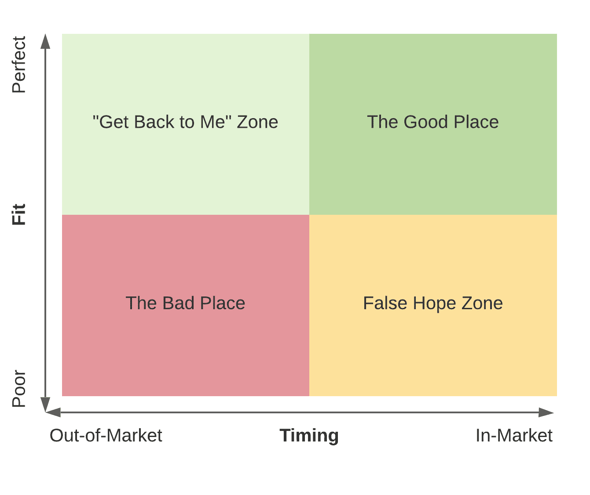
Reps should be spending most of their time in The Good Place. Accounts that fit the ICP and are showing timing signals. Everything else is either a long-term nurture or a trap that burns hours that could go somewhere productive.
The uncomfortable reality for most teams: a significant share of what's in rep books right now is False Hope or The Bad Place. High effort, low return. The spray-and-pray problem isn't primarily a messaging problem — it's an account selection problem.
Three things that change when you go accounts-first
Once you commit to starting with account selection, a few things have to change operationally.
1. Territories become books.
Handing a rep 500 accounts and telling them to prioritize isn't a prioritization system. If anything, it's an abdication. If everything is in scope, nothing gets real attention. Accounts-first teams give each rep a focused book of 100 to 150 high-fit accounts at a time. When an account gets worked and moves on, a better one takes its place. The book stays small, current, and full of accounts worth calling. A rep has roughly 125 selling hours a month; that's the right ceiling to design around.
2. Scoring replaces gut feel.
Defining "right accounts" has to be data-driven to scale. The most reliable method: score accounts by similarity to your actual closed-won customers, not a committee's best guess at an ideal profile. Similarity-based scoring captures what's genuinely working in your business. Rules-based ICP criteria go stale as your customer base evolves; similarity models update with every deal you close.
3. Coverage becomes the primary metric.
Once you've defined which accounts reps should be working, the most important question shifts from "how many calls did we make?" to "what percentage of our priority accounts did we actually engage?" Account coverage (the share of high-fit accounts touched in a given period) is a leading indicator for pipeline. It tells you where the breakdown is happening before it shows up in the forecast. A rep with 80% coverage and low pipeline has a different problem than a rep with 20% coverage and any pipeline at all.
What this produces
When account selection is right, the rest of the stack gets more effective without any other changes. Messaging lands more often because it's going to companies that genuinely fit. Contact data matters more because you're trying to reach the right people at the right place. Activity converts at higher rates because the accounts on the other end are actually worth the effort.
The numbers back this up. Teams that shift to accounts-first book management average +16% more opportunities per rep. Dynamic books — smaller, continuously refreshed account sets built on fit scoring — produce 50% more opportunities than static territories in head-to-head comparisons. For example, one Gradient Works customer went from a 13% to a 20% win rate in a single year after implementing accounts-first scoring and book management.
None of those results came from better messaging or more calls. They came from fixing what was in rep books.
Where to start
If you want to put accounts-first thinking into practice, the diagnostic is straightforward:
- What percentage of your ICP accounts did reps actually engage last quarter?
- If a rep has 400 accounts, can they name their top 20 without looking?
- When pipeline is down, what's the first thing your team reaches for?
If the answers point to untouched accounts, oversized books, or activity as a proxy for results — you have an accounts problem. The fix isn't more calls. It's a better foundation.
Gradient Works is the pipeline platform for commercial sales teams. Market Map scores your account universe by similarity to your best customers. Bookbuilder puts the right accounts in front of every rep automatically. Analytics tracks whether those accounts are converting to pipeline. See how it works.


.png)