



Your Salesforce territories are static. Your accounts aren't.
Enterprise Territory Management assigns accounts once and leaves them until someone notices a problem. Bookbuilder runs natively inside Salesforce and keeps every rep's book current automatically — no rule explosion, no manual rebalancing.
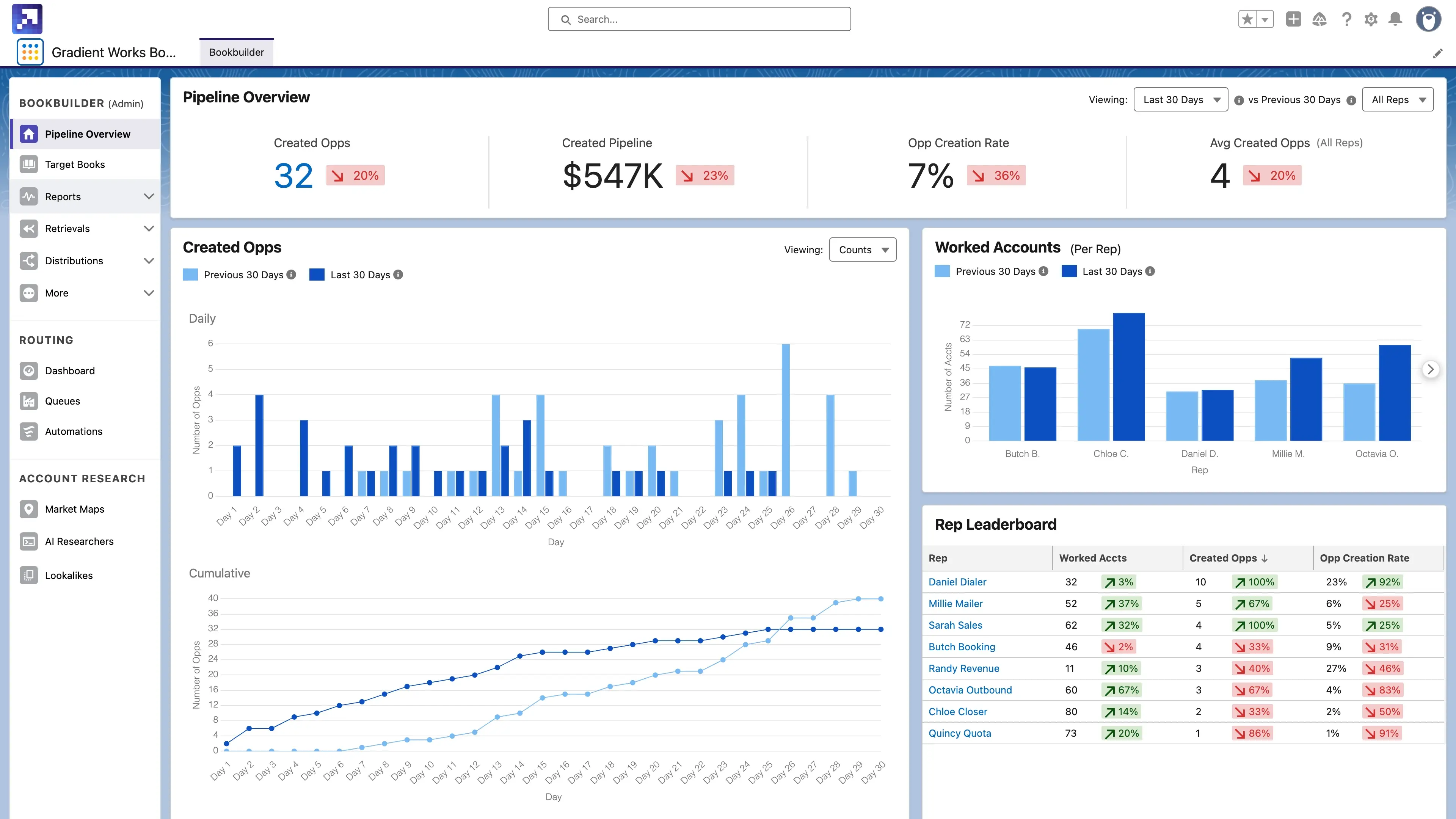
Before and after Gradient Works
Before
- Territory rules multiply with every edge case, until no one can explain why an account is assigned where it is.
- Governor limits and performance degrade as account volume and rule count grow.
- When a rep leaves, someone has to manually reassign their accounts.
- The only fix for a stale territory is a full manual re-carve.
- Unengaged accounts and market drift go unaddressed because no one has time to fix it.
After
- Bookbuilder replaces the rule stack with dynamic books that refresh automatically — no rule count to maintain.
- Assignment runs as a managed Salesforce package, built for account volume that breaks rule-based engines.
- When a rep leaves, accounts return to the ready pool and redistribute the same day.
- Retrievals continuously surface unengaged accounts and replace them with better-fit ones.
- RevOps sets the rules once; the system runs the cycle continuously instead of once a year.
What RevOps does with Gradient Works
Plan
Score your account universe and design the territories your team will actually run. Market Map clusters your TAM by fit so territory boundaries reflect genuine opportunity, not geography.
Execute
Put territory assignments into motion with automated book management and routing. Bookbuilder keeps rep accounts refreshing against their territory; routing enforces ownership on every inbound.
What RevOps leaders say
"We've automated our MQL distribution process with Gradient Works, which has been instrumental to scaling our sales organization for the next stage of our company's growth."
Brandon Smith, Revenue Operations Manager, QuotaPath
"I've carved territories the last 10 years, right? It's never fun. It's something I want to basically eliminate from my job. But after using Carve: I'm looking forward to doing my next carve."
Palen Schwab, Head of Revenue Operations, Liquibase
"For a two-person team like ours, we can now do things at a level and scale that would usually take a 5, 6, or 7-person RevOps organization."
Parker Tipton, Head of Field Ops, Forter
Questions we hear from RevOps teams
Our Salesforce territory assignment rules have gotten too complicated to maintain — what do we do?
Rule complexity in native Enterprise Territory Management usually means the underlying model — a large static rule stack trying to cover every edge case — has outgrown what rules can maintain. Bookbuilder replaces that rule stack with dynamic books: RevOps sets fit criteria once and accounts get scored and distributed continuously, with no rule count to keep growing.
What are Salesforce's best practices for territory management?
The standard native-ETM practices — clean account hierarchy, a small number of broad rules instead of many narrow ones, an annual review cadence — reduce pain but don't remove the core limitation: it's still a static, rule-based model that needs manual maintenance as accounts and reps change. Teams that need territories to change more than once a year typically add a dynamic layer on top of ETM, or replace it, rather than trying to out-rule the problem.
Is there a way to automate territory reassignment in Salesforce?
Yes. Bookbuilder runs as a native Salesforce package and automates account distribution and retrieval — it assigns high-fit accounts to reps and reclaims unengaged ones on an ongoing basis, without anyone manually running a reassignment pass.
How do I rebalance Salesforce territories automatically instead of doing it by hand?
Bookbuilder's distributions and retrievals run on a schedule you set, continuously moving accounts to the reps and segments where they're the best fit and pulling back accounts that have gone unengaged — no manual rebalancing pass required.
What happens to a rep's Salesforce accounts when they leave — is there a way to reassign them automatically?
With Bookbuilder, yes: when a rep leaves, their accounts return to the ready pool and redistribute to the remaining team the same day, using the same fit and capacity rules already in place — nobody has to manually reassign the book.
We're manually rebalancing Salesforce territories every quarter — is there a better way?
Quarterly manual rebalancing is a symptom of a static assignment model. Bookbuilder replaces the quarterly pass with continuous rebalancing — accounts move as reps engage or disengage them, rather than sitting until the next scheduled review.
Is there a good alternative to Salesforce's built-in territory management?
If the pain is Enterprise Territory Management's static rule engine specifically, Bookbuilder is built as a direct replacement for that piece — not a replacement for Salesforce itself. It's a native Salesforce managed package, so your CRM stays the system of record; what changes is the assignment logic underneath it.
Should we replace Salesforce territory management with something else?
If your team is maintaining a large or fragile rule stack, hitting governor limits, or manually rebalancing on a recurring schedule, replacing native ETM's rule engine with a dynamic model is usually worth it. You're not leaving Salesforce — Bookbuilder installs directly into it.
What's the best territory management tool that works with Salesforce?
Depends on what's actually broken. If quota and comp planning are the bottleneck, a broader SPM platform like Anaplan may fit better. If the specific pain is that territories are static and rule-based, Bookbuilder is purpose-built for that — it runs natively inside Salesforce rather than as a separate system to sync.
See what Gradient Works can do for your team
Try it free or book a demo — most teams are up and running in weeks.