In enterprise SaaS, territory planning should accelerate growth. Too often, it slows everything down.
For one global SaaS company with a hybrid GTM motion, territory design had become a recurring source of friction. Every change felt heavy. Every scenario required deep expertise. And every planning cycle pulled RevOps away from higher-impact work.
They knew the process was broken. They just needed a faster way forward.
The problem: Slow planning in a fast-moving GTM
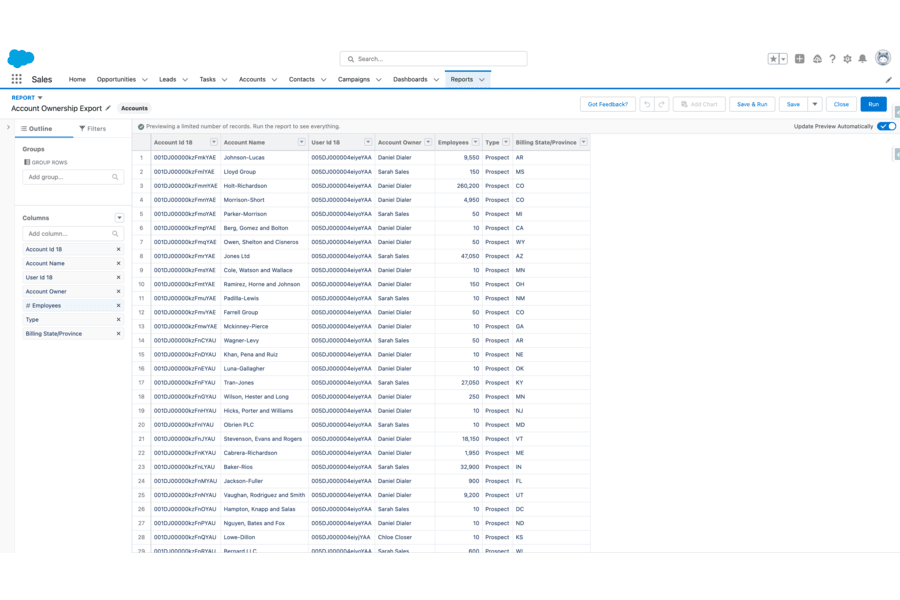
Before adopting Gradient Works, territory modeling relied heavily on spreadsheets, pivot tables, and ad hoc Salesforce reports. Even small changes took hours. Larger initiatives took days.
Because modeling was so manual, teams rarely explored more than one or two options. “What if” scenarios were usually skipped, not because they were unimportant, but because they were too time-consuming to build.
“We just didn’t have time to model five different territory scenarios,” the Deputy VP of RevOps leader shared. “You picked a direction and hoped for the best.”
The result was predictable:
- Territory changes took too long to turn around
- RevOps became a bottleneck during GTM shifts
- Only senior operators could handle complex modeling
- Teams settled for good-enough territory designs
When pricing, packaging, or outbound strategy changed, the operational drag was real.
The shift: Prompt-driven territory modeling with Carve
Carve was introduced to replace their spreadsheet-heavy workflows.
Carve became a workspace for experimentation. Instead of committing early to a single structure, RevOps could model and compare multiple scenarios quickly, then move forward with confidence.
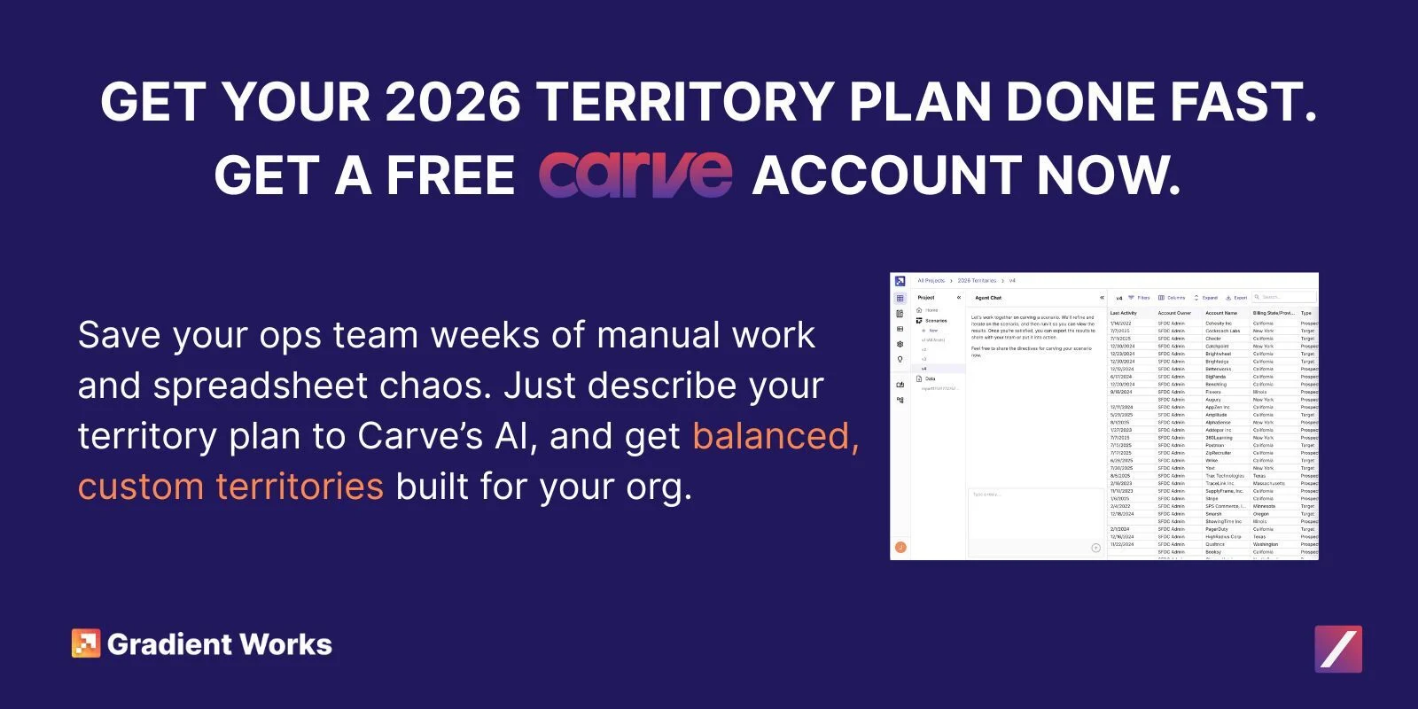
Now, territory modeling doesn’t mean firing up pivot tables or rerunning Salesforce reports. “I describe it as a prompt-based modeling tool,” said Deputy VP of RevOps. “You can chat with it and build your models without living in spreadsheets.”
The team uses Carve to:
- Build and compare territory scenarios in minutes
- Design SDR and AE books with equal opportunity and intent coverage
- Replace pivot tables with prompt-driven modeling
- Delegate full territory projects to junior ops team members
- Test ideas before locking in a final GTM structure
Carve is used during formal planning cycles and throughout the year, whenever a new initiative or change requires fast execution.
What changed for RevOps
- Less time in spreadsheets
- Fairer, more balanced territories
- Easy scenario testing before committing
- Faster execution during GTM shifts
Outcomes: From bottleneck to strategic partner
Before:
- Territory design was slow and manual
- Scenario exploration was limited by effort
- Only senior ops could own planning
After:
- Territory modeling takes minutes, not days
- Teams explore many options, not just A or B
- Junior ops can run projects independently
RevOps no longer slows the business down. It enables faster, more confident decisions.
Results at a glance
- Territory projects now take about 30 minutes
- Full GTM scenarios built in a single sitting
- Fewer spreadsheets, less manual cleanup
- More capacity for strategic work